
The short answer
Key takeaways
- Position one still records the strongest conventional organic placement, but Google’s position metric does not guarantee first-screen visibility, citation in an AI Overview, or a stable click share.
- Ahrefs modeled a 58.0% relative CTR shortfall at position one for its December 2025 desktop informational cohort, declining to 19.4% at position ten; the comparison is observational, not a universal causal effect.
- Amsive found a 27.04% average CTR decline outside the top three in its ten-site client sample, showing that position patterns change with cohort, query intent, and other result-page features.
- Seer’s informational-query cohort averaged 2.07% organic CTR when the tracked brand was cited in an AI Overview, 0.94% when it was not cited, and 3.35% when no overview appeared.
- The defensible measurement stack separates organic position, AI Overview exposure, citation status, clicks, and downstream outcomes instead of treating rank as the final result.
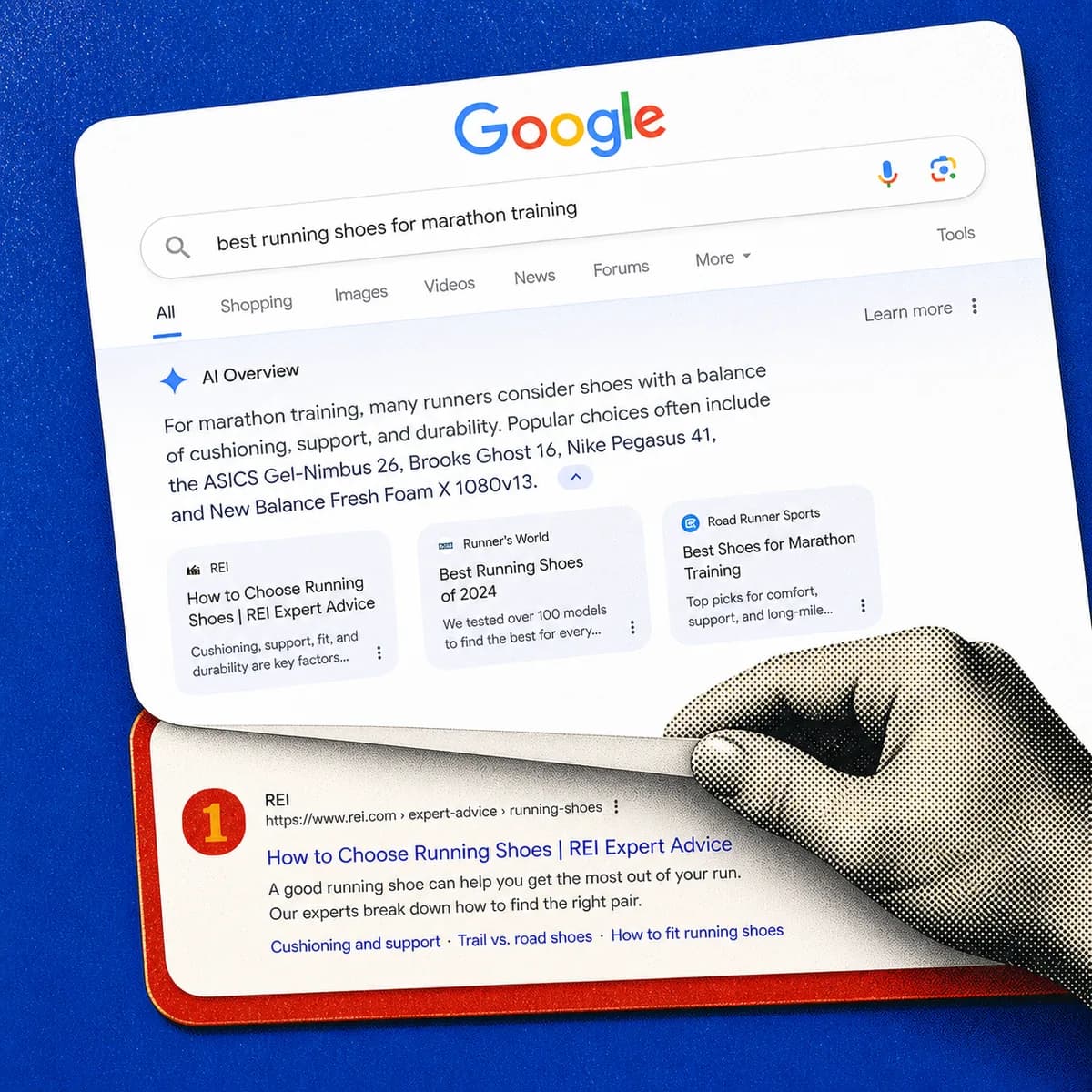
Ranking first still matters. What changed is what first place promises: a page can remain number one among organic results while a generated answer occupies the space, citations, and attention above it.
Position-level CTR studies do not produce one universal AI Overview discount. Read together, they show why rank remains useful—and why exposure, citation, clicks, and business outcomes now need separate measurement.
The Short Answer: Rank One Still Matters, but It No Longer Means First
Yes, ranking first still matters when Google shows an AI Overview. The first organic result remains the strongest conventional placement, and it can still earn clicks, visibility and consideration. But the meaning of “first” has narrowed. It describes where a page ranks among organic results; it does not guarantee that the page is the first thing a searcher sees, the first source cited, or the result that receives the largest share of attention.
The click data makes that distinction concrete. In Ahrefs’ December 2025 desktop informational-query cohort, the observed click-through rate for position one was 1.5677%. Its modeled no-AI-Overview counterfactual was 3.734%. The observed rate was therefore 58% below the model—not a raw 58-point fall, and not proof that every AI Overview causes the same loss.
The effect also changes by position, query class, citation status and time. Ahrefs modeled its largest relative shortfall at position one. Amsive found larger average declines outside the top three in its client sample. Seer found that an AIO-present click gap narrowed between December 2025 and February 2026, and that cited brands outperformed brands absent from the AI Overview’s sources. These findings are not contradictory. They show that rank is one variable inside a changed results page, not a complete forecast of traffic.
The practical answer is to keep pursuing strong organic positions while measuring four additional things separately: whether an AI Overview appeared, whether the page or brand was cited, whether the impression became a click, and whether the visit produced a useful outcome.
What Position One Actually Measures
Google Search Console defines position as the topmost position occupied by a site’s link within a search result. The value is then averaged across impressions. It is an element-level accounting rule, not a pixel coordinate, attention score or promise that the link appeared above every other feature.
That boundary becomes important on a page with an AI Overview. Google treats the overview as one search result element. Links inside it share the position of that element. The first conventional organic listing can therefore remain number one in an SEO rank tracker while appearing below a generated answer, citations, shopping units or another search feature in the visible page.
This is why “we still rank first” and “our clicks fell” can both be true. The page retained its relative place in the organic list while the interface around that list changed.
Advanced Web Ranking’s CTR benchmark methodology reflects the same reality. Its curves are derived from Search Console data and can be segmented by device, intent, branded versus unbranded searches, industry, time and combinations of search features. There is no single durable CTR attached to the numeral one. A position predicts click propensity only within a particular result-page and query context.
The Position-by-Position Data
Ahrefs’ 2026 update offers the clearest public position-level comparison in the current source set. It began with 300,000 keywords: 150,000 that showed an AI Overview in the latest classification and 150,000 informational control keywords that did not. The study used aggregated desktop Search Console data and applied the latest AIO label retrospectively.
For position one, the AIO-labeled cohort’s CTR fell from 7.2627% in December 2023 to 1.5677% in December 2025. The control cohort also declined sharply over the period. Ahrefs transferred that control decline to the AIO cohort’s earlier baseline, producing a modeled December 2025 CTR of 3.734% without the additional AIO-associated gap. The observed 1.5677% rate was 58% below that counterfactual.
The same model found smaller relative shortfalls farther down the page, though every position in the top ten remained below its modeled comparison.
The modeled AIO-associated CTR shortfall was largest at position one
Relative shortfall against modeled no-AIO CTR by organic position, desktop informational queries, December 2025
Ahrefs modeled a 58.0% relative shortfall at position one, declining unevenly to 19.4% at position ten.
Source: Ahrefs, 2026 update. The study applied latest-state AIO labels retrospectively to aggregated Search Console data. Values are modeled observational gaps, not causal effects or absolute CTR.
This chart requires careful reading. A smaller relative shortfall at position ten does not make position ten more valuable than position one. Lower positions generally begin with fewer clicks, so there is less click share to lose. The result instead suggests that the interface change can compress the advantage traditionally associated with the top listing.
It is also an observational model. The AIO and control keyword groups may differ in intent, layout, demand and other features. Applying the latest AIO label to earlier history enables the comparison but cannot identify when an overview first appeared on every impression. The 58% value is a useful benchmark for one cohort, not a universal causal constant.
Why Lower Positions Can Show a Different Pattern
Amsive’s 2025 client analysis helps explain why the position gradient should not be reduced to “the top result loses most.” The agency analyzed a 700,000-keyword universe, including 10,000 keywords that both triggered AI Overviews and ranked for one of ten client sites across five industries. It reported a 15.49% average CTR decline overall, but a 27.04% decline for results outside the top three.
That subgroup result points in a different direction from Ahrefs’ modeled relative shortfall. The methods are measuring different populations and comparisons. Ahrefs estimated an AIO-associated gap by organic position across a large desktop informational cohort. Amsive followed the ranked keywords of a smaller commercial client set. One asks where the modeled relative gap is largest; the other asks how client keywords in ranking bands changed on average.
The Amsive study also reported a 19.98% decline for nonbranded queries, an 18.68% increase for branded queries, and a 37.04% decline when an AI Overview appeared with a featured snippet. Those splits reinforce the central point: position alone cannot describe the competition for a click. Familiarity, intent and the rest of the result page change the available paths.
For a publisher, the defensible interpretation is not that one study cancels another. It is that the value of rank one must be estimated within the site’s own query mix and search-feature environment.
Citation Status Changes the Click Outcome
An AI Overview does not merely occupy space. It can also select sources. That creates a second contest after ranking: whether the tracked page or brand appears inside the generated element.
Seer Interactive’s 2026 update analyzed 5.47 million distinct queries and 2.43 billion organic impressions across 53 client accounts. For informational queries, average organic CTR was 3.35% when no AI Overview appeared, 2.07% when an overview appeared and cited the tracked brand, and 0.94% when an overview appeared without citing it.
Citation status separated AIO-present click outcomes
Average aggregate organic CTR for informational queries in Seer Interactive’s 53-account cohort, January 2025 to February 2026
CTR averaged 3.35% without an AIO, 2.07% when the tracked brand was cited, and 0.94% when it was not cited.
Source: Seer Interactive, 2026. Latest-state AIO labels were applied retrospectively. The uncited segment was materially influenced by one large account; the comparison is associative, not causal.
In that cohort, citation was associated with more than twice the CTR of the uncited AIO condition, but it did not restore CTR to the no-AIO level. The lowest figure also needs a caveat: one account supplied 47% of that segment’s impressions at a 0.20% CTR. Seer estimated the segment at about 1.61% without that account.
The comparison cannot prove that citation caused the higher CTR. Pages that earn citations may differ in brand strength, relevance, rank or query mix. It nevertheless exposes a blind spot in a rank-only report. Two pages can both rank first below an AI Overview while one is named in the generated answer and the other is absent. Their search visibility is not equivalent.
The CTR Penalty Is Not Fixed
Seer’s time series also shows why teams should resist freezing one headline percentage into a permanent forecast. Across all in-scope queries, organic CTR with an AI Overview was 1.31% in December 2025 and 2.36% in February 2026. CTR without an AI Overview rose from 3.16% to 3.82% over the same endpoints.
The AIO click gap narrowed after December, but it did not disappear
Aggregate organic CTR, all in-scope queries in Seer Interactive's 53-account cohort, December 2025 to February 2026
CTR rose from 1.31 to 2.36 percent on AIO-present queries and from 3.16 to 3.82 percent on queries without an AIO.
Source: Seer Interactive, 2026. Latest-state AIO labels were applied retrospectively. Two endpoints show a rebound, not a stable trend or causal effect.
The AIO-present gap remained material in February, but it narrowed. Two endpoints do not establish a stable recovery trend. Google can change when overviews appear, how citations are presented and what kinds of queries trigger them. The query mix can change too. Seer also applied a latest-state AIO label retrospectively, which limits the timing claim.
The useful lesson is narrower: the value of first place is not governed by one permanent AIO discount. It should be re-estimated as the interface, coverage and user behavior change.
Pew Research Center provides independent user-level evidence in the same general direction. In a March 2025 browsing panel of 900 U.S. adults, users clicked a traditional result on 8% of visits when an AI summary appeared, compared with 15% when one did not. They clicked a source inside the summary on 1% of AIO visits. Those are visit-level behaviors, not publisher CTR or position-one estimates, but they support the conclusion that an AI summary can reduce outbound clicking.
How Google’s Stable-Clicks Claim Can Also Be True
Google said in August 2025 that total organic click volume from Search to websites was relatively stable year over year and that the quality of clicks had increased slightly. That claim can coexist with lower CTR in AIO-heavy cohorts.
Google was describing the platform total. Ahrefs, Amsive and Seer were studying selected query and publisher slices. Losses on informational desktop searches could be offset by more searches, growth on other query types, changes across devices or redistribution toward different sites. Stable aggregate clicks do not mean stable clicks for every publisher or every first-place result.
The public Google statement also included no numerical series, denominator, sample definition or reproducible method. It should be treated as an official aggregate claim, not as a substitute for segmented site evidence.
A Better Way to Measure the Value of Rank One
A rank report should remain part of the operating system. It identifies whether a page is competitively placed and helps explain changes in impressions and opportunity. It should no longer be the final column.
Position one is only the first observation in a five-part measurement stack
Distinct search-performance observations and their strongest interpretation boundary
Organic position, AI Overview exposure, citation status, clicks, and business outcomes are separate observations. No stage proves the next.
Organic position: Relative placement among recorded Google result elements. It is not a literal pixel coordinate or attention measure.
Sources: Google Search Console metric definitions, Google Search Central AI-features guidance, and the 2026 generative-AI reporting announcement. Connections show analytical order, not causation or a measured funnel.
Use five separate observations:
- Record organic position for a stable query-page cohort. Separate brand from nonbrand, informational from commercial intent, and desktop from mobile.
- Record whether an AI Overview appeared on the actual result page. Avoid applying one current label to months of history when timing matters.
- Record whether the page or brand was cited and where the citation appeared. Exposure inside the generated element is different from ranking below it.
- Measure impressions and clicks separately. A CTR decline at stable impressions is a different problem from declining demand or lost rankings.
- Carry the click to an outcome: engaged sessions, subscriptions, qualified leads, revenue or another goal the page is meant to produce.
No stage automatically proves the next. A citation can produce no click. A click can produce no value. A smaller click volume can contain better-qualified visits. This is why Google’s claim about click quality cannot be confirmed or rejected from CTR alone.
Google’s standard Search Console Web report includes traffic from AI Overview links, but its ordinary position and click fields do not provide a complete historical AIO experiment. Google began a limited rollout of dedicated generative-AI performance reports in June 2026, exposing impressions by pages, countries, devices and dates. That improves visibility into exposure, but the launch fields do not by themselves isolate click or conversion effects.
What to Do When You Already Rank First
If a page ranks first and an AI Overview appears, do not abandon the query automatically. First determine which value the page still creates.
- Inspect whether the page is cited. If it is not, compare the claims, evidence and source fit of cited pages without assuming that formatting alone causes selection.
- Watch absolute clicks as well as CTR. Growing demand can make a lower rate economically worthwhile; shrinking impressions can make a stable rate misleading.
- Segment by intent and brand. Branded and transactional journeys can behave differently from broad informational questions.
- Improve the destination outcome. When clicks are scarcer, the value of a clear answer, strong next step and credible conversion path increases.
- Test clusters, not anecdotes. A single query can change because of seasonality, a layout experiment or a ranking movement unrelated to the overview.
Ranking first still protects optionality. Google says pages supporting AI features must be indexed and eligible to appear with a snippet, with no additional technical requirement beyond the ordinary Search foundation. Strong organic pages can therefore compete for both the conventional result and the generated answer’s sources. But eligibility is not selection, and selection is not a click.
Methodology and Limitations
This Data Report reconstructs how the value of ranking first changes when an AI Overview is present. It compares position-specific CTR shortfalls, citation incidence, traffic trends, and Google's counting rules while keeping each study's population, unit, date, and comparison design separate.
The evidence base contains ten full-text sources: two Ahrefs studies, a Pew browsing-panel study, Amsive and Seer client analyses, three Google documentation or reporting pages, one official Google traffic statement, and Advanced Web Ranking’s benchmark methodology. The research cutoff is August 29, 2026. The position chart reproduces Ahrefs’ reported modeled relative CTR shortfalls for positions one through ten. The citation and time-series visuals reproduce Seer’s aggregate reported values. This is original comparative analysis of published evidence, not original collection of query, click, or browsing data. No values from different studies are combined into a pooled estimate because their populations, units, dates and comparison designs are incompatible.
Vendor and agency studies are treated as observational evidence. Their cohorts are commercially sourced and their latest-state AIO labeling cannot establish treatment timing or causation. Pew provides independent user behavior but not publisher-level or position-specific CTR. Google documentation is authoritative for product counting rules, while the company’s traffic statement lacks enough public detail for independent replication.
Conclusion: First Place Is a Starting Position, Not the Whole Outcome
Ranking first still matters because relative organic placement remains a strong input to visibility and click opportunity. What changed is the promise attached to it. Number one no longer reliably means first on the screen, selected as an AI source, or entitled to a familiar CTR.
The evidence does not support one universal discount. Ahrefs found a large modeled position-one shortfall. Amsive found sharper average declines outside the top three in its client set. Seer showed a persistent but narrowing AIO gap and a meaningful association with citation status. Pew observed less outbound clicking when summaries appeared. Each result describes a different layer of the same changed page.
The operating rule is therefore simple: keep rank, but stop using rank alone. Measure the interface above the listing, the citation inside it, the click that follows and the business result after the click. Position one remains valuable. It is no longer the verdict.
Frequently asked questions
Usually, relative to lower organic positions in the same result-page context. But an AI Overview and other features can reduce the absolute click share available to every conventional listing, including number one.
No. It is the relative gap between Ahrefs’ observed position-one CTR and its modeled no-AIO counterfactual for a desktop informational-query cohort. The authors describe the relationship as correlational.
Not necessarily. Search Console position describes placement among search-result elements. An AI Overview or another feature can appear above the first conventional organic listing.
Seer’s informational-query cohort suggests so: cited brands averaged 2.07% organic CTR versus 0.94% when the overview appeared without citing the tracked brand. The association does not prove citation caused the difference.
Standard Web reporting includes AI Overview links under Google’s counting rules. A limited dedicated generative-AI report began rolling out in 2026 with exposure dimensions, but the launch fields did not provide a complete click-and-conversion experiment.
No. Rankings remain useful for competitive placement and diagnosis. Add AIO exposure, citation status, clicks and downstream outcomes so the rank is interpreted in context.
Sources
- Law, R. (2026, February 4). “AI Overviews Reduce Clicks by 58%.” Ahrefs. https://ahrefs.com/blog/ai-overviews-reduce-clicks-update/
- Law, R. (2025, April 17). “AI Overviews Reduce Clicks by 34.5%.” Ahrefs. https://ahrefs.com/blog/ai-overviews-reduce-clicks/
- McClain, C. (2025, July 22). “Google users are less likely to click on links when an AI summary appears in the results.” Pew Research Center. https://www.pewresearch.org/short-reads/2025/07/22/google-users-are-less-likely-to-click-on-links-when-an-ai-summary-appears-in-the-results/
- Amsive. (2025, April 16). “Google AI Overviews: New CTR Study Reveals How to Navigate Negative SERP Impact.” https://www.amsive.com/insights/seo/google-ai-overviews-new-research-reveals-how-to-navigate-click-drop-off/
- Seer Interactive. (2026, April 24). “AIO Impact on Google CTR: 2026 Update.” https://www.seerinteractive.com/insights/aio-impact-on-google-ctr-2026-update
- Reid, L. (2025, August 6). “AI in Search is driving more queries and higher quality clicks.” Google. https://blog.google/products-and-platforms/products/search/ai-search-driving-more-queries-higher-quality-clicks/
- Google Search Console Help. “What are impressions, position, and clicks?” https://support.google.com/webmasters/answer/7042828?hl=en
- Google Search Central. “AI features and your website.” https://developers.google.com/search/docs/appearance/ai-features?hl=en
- Maoz, H., & Samet, M. (2026, June 3). “Introducing Search Generative AI performance reports in Search Console.” Google Search Central Blog. https://developers.google.com/search/blog/2026/06/gen-ai-performance-reports
- Advanced Web Ranking. “Google Organic CTR History.” https://www.advancedwebranking.com/free-seo-tools/google-organic-ctr